Successful house hunting requires a good real estate agent, and a good real estate agent is probably not going to be a friend or family member, a friend of a friend, or the husband, wife, or other relative of a friend. Unless you're really lucky, those people will not be at the top end of the profession. Lots of people have a real estate license because they've taken the required classes and paid the annual fee, but that doesn't mean they're good at it. You want a real estate agent who is truly a professional. That's someone who has done it for a living for at least three years, not just dabbled in it part-time.
Many house hunters wind up with the real estate agent who answers the phone when they call to ask about a house that's listed in the newspaper. They go with the agent to see the house, the agent offers to show them other houses, and that's the way a business relationship involving hundreds--or at least tens--of thousands of dollars starts. That person might never have sold a house before, might have no clue about the area the person wants to buy in, and might not have even bought a house of their own before, but if a buyer decides to use that person as an agent, the agent will be in a position to fail to show the buyer an appropriate selection of houses, neglect to follow up on the buyer's interests in a timely manner, have no knowledge of the neighborhood the house is in, and cost the buyer thousands of dollars in the negotiating process.
I suggest two options for finding a quality real estate agent. The first is to do a little research on the Internet and find out which agents are making the most money and which have the largest number of sales under their belt in the last couple of years. Some agents specialize as buyer's agents, so their sales statistics will be focused less on the number of houses they listed and more on the number of people they worked with to buy a house. The second method is to talk to friends and colleagues about the agents they used when buying a house. Once someone has some experience with an agent, you will know that agent's strengths and weaknesses--for example, if the agent takes a day or so to return a customer's phone call, that's a sign of a bad agent--and friends and colleagues are likely to tell you these things.
With either option, you should interview the agent, dump him/her quickly if you're not happy with them for whatever reason (there are plenty more out there), and be careful what you sign--some buyer's agents insist on a contract that will commit you to them for a number of months. If you're convinced that signing an agreement will increase the person's loyalty to you as opposed to the seller, then go for it, but you can do it on your terms--two months instead of six, for example.
It might seem a bit mean to avoid giving your business to someone just starting out, especially if they are a friend or a family member. After all, you'd be willing to go to a brand new doctor, right? If you answered yes, that probably means that you were thinking, yeah, a brand new doctor just out of med school would know all the latest science on diseases and medications and all of the new diagnostic techniques. But real estate is much different. Knowledge in real estate means knowledge of neighborhoods, good working relations with fellow agents, and experience on nailing down a deal--stuff that can't be taught in a generic real estate class. A house probably will be your biggest purchase ever, but as they say, it's your money.
Thursday, December 11, 2008


Sunday, December 7, 2008
My Mother's House, Part I
 The process of finding a house for my mom and dad required factoring in their interests along with mine, Tom's, and three dogs'. My mom and dad wanted a house with at least four bedrooms, a family room, a fireplace, a decent sized yard, a two-car garage, and a price tag under $700K. I wanted a place that would give Tom and me privacy, would give us several rooms for our furniture, etc., since we would be selling our condo in Arlington, VA, in order to live there, and would require no more than a half hour's commute for me to work. Plus, I wanted to minimize the amount of stairs my mom and dad would routinely need to use to get around in the house. Tom wanted a place that would not require us to be on the loan, given that we were trying to marshal our money and credit for major work on our house in Annapolis. The dogs needed a fenced yard.
I called Darrell Lewis, the agent my friend Stephanie had recommended to me several years ago when Tom and I decided to buy a condo. Darrell had helped her find an incredibly good buy in Arlington, and she noted that not only was he a pleasure to work with, attentive to what she was looking for, and responsive in terms of phone calls and follow ups, he also knew the area extremely well. We had the same experience when we worked with him. When Darrell got my call, he remembered me immediately. We arranged to meet up, and meanwhile he e-mailed me an array of links to information about specific houses that seemed to come close to my requirements. Some realtors won't let you know that this is possible, or they'll send you a censored version. The good ones don't hide info from their clients.
Each time we'd go out in Darrell's Cadillac, he would prepare a list of at least eight places to see and if the houses were occupied, he'd let the residents know we were coming, and then have a print out of our route so that I could navigate. Along the way, we'd talk about houses, neighborhoods, buyers, sellers, people in general, politics, and Persian rugs. A few weeks and about 40 houses later, I found the one I wanted: nice neighborhood, about 20-30 minutes from my work depending on traffic, nice house, fenced yard, carport, family room with a fireplace, five bedrooms, three bathrooms, and the lower floor (which was below grade on the front side of the house and above grade in the back so that the main entrance is on the upper floor) made a very nice "in-law apartment" for Tom, the dogs, and me.
But it had more. The bathrooms had been updated. It had a white pergola with vines growing on it off the kitchen entrance through French doors at the front of the house, perfect for an outdoor breakfast or lunch during nice weather. It had two decks, one off the upper floor and another one along the whole back side of the house. It had lots of storage, including a separate storage shed. But particularly enchanting, especially given the decks, was the backyard. It was a woods of our own, with tall trees, many with bird houses, and the fact that the house was on a hil gave both floors beautiful views of our little wilderness. An added plus was the fact that behind the house was a continuation of the woods, land owned by the state of Virginia as part of the Annandale campus of Northern Virginia Community College (NOVA).
I knew my mom and dad would like the house--it had most of their wish list--but at that point I had very little interest in convincing them that it was the right place. They had said that it was up to me, and my dad's condition and the poor treatment he was getting back in Indiana meant that I needed to shift from finding a house to closing on a house.
Sunday, November 30, 2008
Eldercare Lessons
My mom and dad are the only people I know whom real estate agents have dumped out of frustration. They looked at a lot of houses in the Annapolis area and then a few in Virginia, but nothing quite worked--no garage, not enough bedrooms, no basement, yard too small--and Tom and I eventually concluded that they didn't really want to move.
When the crunch came--when my mom and dad became unable to care for themselves, I realized that I had wasted a lot of time. This wasn't a matter of siblings being unable to agree on who will take care of mom and dad. I'm an only child. My dad had had a series of illness--all without me being there--that I should have added up to realize that when a man is in his 80s and has had a stroke, cancer, heart, hearing, and eye problems, it's probably beyond the point in time when he and my mom--who does not drive--should be expected to watch over themselves, even though they were doing pretty well until their 88th year.
Part of the problem was that they were doing pretty well, they were happy where they were, they'd spent nearly all their lives in the area, and the extended family was for the most part less than a hundred miles away. Wasn't it better to leave well enough alone?
Well, not quite, because as the days, months, and years went buy, things were changing just as they do for everyone in their 80s. They were slowly approaching a health crisis, and in this case it lasted for months before it turned fatal for my dad. During those four months, I was madly juggling house hunting/buying (including arranging for a loan), calls to doctors, hospitals, and nursing homes, and long talks with my mom, who was at home alone, on top of working a full-time job. In the course of all this, I learned the following things that I am applying to my mother's care and hope to be able to apply to my own welfare and Tom's when we get older. Those of you who read this might well have learned your own lessons while trying to care for elderly parents or other aging family members. I invite you to send them to me so I can add them to the list.
1. Many doctors do not consider elderly patients as deserving of the same care and consideration as younger patients. They will delay visiting your loved one at the hospital and be dismissive to you as a family member. "Well, what can you expect, he's 88 years old" becomes an excuse for the doctor's preference to do something other than give your parent the best care.
2. Nurses working night shifts at hospitals and nursing homes like peace and quiet during their shift, even at the expense of your elderly loved one. Let's face it, few people get used to working nights, especially women who have young children that require their attention, causing a lack of sleep. When these folks get to work, they want a quiet shift so that the stress of working at night is minimized. Old people often have a condition called "sundowning," where there days and nights are mixed up that ruin the tranquility of the workplace. If drugs will cause your elderly loved one to quiet down, then the nurses will see to it that they get the drugs, even if it means calling a doctor to authorize it and even if the drugs will complicate the overall treatment of what has caused the elderly person to be in the hospital. My dad was having trouble sleeping at night in the rehabilitation department of Union Hospital in Terre Haute. After complaints from the nurses, his rehabilitation doctor (not a neurologist, not a psychiatrist) was given halydol--an antipsychotic drug that I had asked them not to give him--AND DOUBLED HIS BLOOD PRESSURE MEDICINE. The next day his condition declined dramatically--he could barely move. I consider this one of several turning points that not only set back his recovery but directly contributed to his death.
3. Warnings that certain drugs can be fatal to the elderly (so-called black box drugs) are routinely ignored by medical professionals. If your elderly loved one is not sleeping at night, they will be given one of these hazardous drugs, most designed to treat severe psychotic illness--and you won't know about it unless you ask. Even if you tell the nurses caring for your loved one at a hospital or nursing home that you don't want black box drugs given, they might comply initially, but when they think you're no longer focused on the issue, they'll start dosing them out again after getting a doctor's permission.
4. Getting a home loan is not easy for the elderly, even if they have a lot of money in the bank and a steady pension income, and an impeccable credit record.
5. If you or someone you love is in their 80s, their chances of being "healthy" one day and dead the next are astronomically higher than for those under 80. If your loved one is 80 or older and has been hospitalized, expect a phone call with bad news at any time.
6. Your elderly family member may exhibit aggressive behavior of the kind you've never seen before; it is a natural but primitive response to change, so don't let it hurt your feelings. When he was in the hospital in Indianapolis, the nurses called the police on my dad because he had become combative. It took four physically fit men in their 30s to hold him down. Why did he get combative? Because he wanted out of there.
7. Nurses would rather have their elderly patients wear diapers or a catheter than take them to the bathroom. One of the standards for quality nursing home care is the percentage of patients who become incontinent while staying at the home. I'm pretty sure this is because the reason many of the elderly become incontinent because their toilet needs are neglected by the home's staff. My dad would call to be assisted to go to the bathroom and was ignored. His nurses had him in diapers, so they didn't have to worry about a messy bed, and helping a big man get up was a chore. I used to get calls from the nursing home complaining that my dad kept falling out of his bed or sliding out of his wheel chair. When I asked him why he did this, he said, "I know it's not going to hurt me, and it's the only way I can get their attention."
8. Therapists will use Medicare against you to avoid having to work hard to help elderly patients. The therapists at Meadows Manor East, the nursing home my dad was sent to when he was released from Union Hospital, found my dad to be hard to manage sometimes, so they dropped him as a patient. Twice. The first time the physical therapist told me that my dad was making some progress. The nurse all told me that my dad was making progress. But then suddenly my mom got a letter from Medicare saying that my dad was being dropped from therapy. When I confronted the therapists about it, they said that to continue therapy would be an abuse of Medicare, which would pay significantly more for my dad's care in a nursing home if he was undergoing rehabilitation as opposed to just custodial care. They claimed that he had not been making progress over a two week period even though every time I asked specifically about how he was doing in therapy, I was told he was doing fine. After my dad was sent to the hospital because the drugs Meadows East was giving him--the black box drugs--were causing him to be comatose during the day and crazy at night, he returned to Meadows East. The doctor prescribed therapy for him once again, but the therapists tried for one day and then called me to say it wasn't working out and that they had decided to drop him. One day. Now if they were right, then why did my dad do so well at therapy a week later at Fairfax Nursing Center in Fairfax, VA? He was making progress for weeks until the day he was hospitalized for pneumonia.
9. With any medical treatment your loved one receives, find out what type of follow-up care will be required and make sure it gets done. My dad had a tube surgically implanted in his stomach because all the medications he had been on had impaired his ability to swallow. The doctor who proposed that it be installed was worried that my dad would aspirate his food and get pneumonia. Unfortunately, in tandem with the installing of the tube was the requirement that mucus that accumulated over time in the back of his throat be suctioned out because he couldn't swallow it down himself. Mucus accumulates a lot of germs and normally it goes into the stomach where the acids there kill them. In my dad's case, the nursing staff failed to follow through on the suctioning, and that failure caused the germs to stay in the mucus in the back of his throat, where they proceeded to multiply and eventually get into his lungs and cause pneumonia, the very thing the stomach tube was supposed to prevent. I'm sure suctioning out mucus is not the most pleasant job in the world for nurses, and elderly patients come and go for a variety of reasons, so maybe they don't connect this particular failure with deadly negligence. For whatever reason, it falls in the loved one's court to make sure it happens.
10. You might be right and the doctor might be wrong, and the consequences of his error could be deadly, especially with the elderly, so insist that the doctor take your view seriously and prove that your wrong. When my dad was rushed to the Fairfax Hospital's emergency room, I stayed there with him until 1 a.m. or so to talk to the doctor. During our talk, the doctor said, "we need to find out what the source is for this infection." I said, "What about the back of his throat, maybe mucus has accumulated there since he can't swallow?" The doctor said, "If that were the case, he would be coughing more." In hindsight I should have said, "Why don't you look and see?" Twenty-four hours later, when my dad's vital signs dropped the first time, they did look and found a huge accumulation of very nasty stuff. An hour later he was dead.
(To be continued . . . )
When the crunch came--when my mom and dad became unable to care for themselves, I realized that I had wasted a lot of time. This wasn't a matter of siblings being unable to agree on who will take care of mom and dad. I'm an only child. My dad had had a series of illness--all without me being there--that I should have added up to realize that when a man is in his 80s and has had a stroke, cancer, heart, hearing, and eye problems, it's probably beyond the point in time when he and my mom--who does not drive--should be expected to watch over themselves, even though they were doing pretty well until their 88th year.
Part of the problem was that they were doing pretty well, they were happy where they were, they'd spent nearly all their lives in the area, and the extended family was for the most part less than a hundred miles away. Wasn't it better to leave well enough alone?
Well, not quite, because as the days, months, and years went buy, things were changing just as they do for everyone in their 80s. They were slowly approaching a health crisis, and in this case it lasted for months before it turned fatal for my dad. During those four months, I was madly juggling house hunting/buying (including arranging for a loan), calls to doctors, hospitals, and nursing homes, and long talks with my mom, who was at home alone, on top of working a full-time job. In the course of all this, I learned the following things that I am applying to my mother's care and hope to be able to apply to my own welfare and Tom's when we get older. Those of you who read this might well have learned your own lessons while trying to care for elderly parents or other aging family members. I invite you to send them to me so I can add them to the list.
1. Many doctors do not consider elderly patients as deserving of the same care and consideration as younger patients. They will delay visiting your loved one at the hospital and be dismissive to you as a family member. "Well, what can you expect, he's 88 years old" becomes an excuse for the doctor's preference to do something other than give your parent the best care.
2. Nurses working night shifts at hospitals and nursing homes like peace and quiet during their shift, even at the expense of your elderly loved one. Let's face it, few people get used to working nights, especially women who have young children that require their attention, causing a lack of sleep. When these folks get to work, they want a quiet shift so that the stress of working at night is minimized. Old people often have a condition called "sundowning," where there days and nights are mixed up that ruin the tranquility of the workplace. If drugs will cause your elderly loved one to quiet down, then the nurses will see to it that they get the drugs, even if it means calling a doctor to authorize it and even if the drugs will complicate the overall treatment of what has caused the elderly person to be in the hospital. My dad was having trouble sleeping at night in the rehabilitation department of Union Hospital in Terre Haute. After complaints from the nurses, his rehabilitation doctor (not a neurologist, not a psychiatrist) was given halydol--an antipsychotic drug that I had asked them not to give him--AND DOUBLED HIS BLOOD PRESSURE MEDICINE. The next day his condition declined dramatically--he could barely move. I consider this one of several turning points that not only set back his recovery but directly contributed to his death.
3. Warnings that certain drugs can be fatal to the elderly (so-called black box drugs) are routinely ignored by medical professionals. If your elderly loved one is not sleeping at night, they will be given one of these hazardous drugs, most designed to treat severe psychotic illness--and you won't know about it unless you ask. Even if you tell the nurses caring for your loved one at a hospital or nursing home that you don't want black box drugs given, they might comply initially, but when they think you're no longer focused on the issue, they'll start dosing them out again after getting a doctor's permission.
4. Getting a home loan is not easy for the elderly, even if they have a lot of money in the bank and a steady pension income, and an impeccable credit record.
5. If you or someone you love is in their 80s, their chances of being "healthy" one day and dead the next are astronomically higher than for those under 80. If your loved one is 80 or older and has been hospitalized, expect a phone call with bad news at any time.
6. Your elderly family member may exhibit aggressive behavior of the kind you've never seen before; it is a natural but primitive response to change, so don't let it hurt your feelings. When he was in the hospital in Indianapolis, the nurses called the police on my dad because he had become combative. It took four physically fit men in their 30s to hold him down. Why did he get combative? Because he wanted out of there.
7. Nurses would rather have their elderly patients wear diapers or a catheter than take them to the bathroom. One of the standards for quality nursing home care is the percentage of patients who become incontinent while staying at the home. I'm pretty sure this is because the reason many of the elderly become incontinent because their toilet needs are neglected by the home's staff. My dad would call to be assisted to go to the bathroom and was ignored. His nurses had him in diapers, so they didn't have to worry about a messy bed, and helping a big man get up was a chore. I used to get calls from the nursing home complaining that my dad kept falling out of his bed or sliding out of his wheel chair. When I asked him why he did this, he said, "I know it's not going to hurt me, and it's the only way I can get their attention."
8. Therapists will use Medicare against you to avoid having to work hard to help elderly patients. The therapists at Meadows Manor East, the nursing home my dad was sent to when he was released from Union Hospital, found my dad to be hard to manage sometimes, so they dropped him as a patient. Twice. The first time the physical therapist told me that my dad was making some progress. The nurse all told me that my dad was making progress. But then suddenly my mom got a letter from Medicare saying that my dad was being dropped from therapy. When I confronted the therapists about it, they said that to continue therapy would be an abuse of Medicare, which would pay significantly more for my dad's care in a nursing home if he was undergoing rehabilitation as opposed to just custodial care. They claimed that he had not been making progress over a two week period even though every time I asked specifically about how he was doing in therapy, I was told he was doing fine. After my dad was sent to the hospital because the drugs Meadows East was giving him--the black box drugs--were causing him to be comatose during the day and crazy at night, he returned to Meadows East. The doctor prescribed therapy for him once again, but the therapists tried for one day and then called me to say it wasn't working out and that they had decided to drop him. One day. Now if they were right, then why did my dad do so well at therapy a week later at Fairfax Nursing Center in Fairfax, VA? He was making progress for weeks until the day he was hospitalized for pneumonia.
9. With any medical treatment your loved one receives, find out what type of follow-up care will be required and make sure it gets done. My dad had a tube surgically implanted in his stomach because all the medications he had been on had impaired his ability to swallow. The doctor who proposed that it be installed was worried that my dad would aspirate his food and get pneumonia. Unfortunately, in tandem with the installing of the tube was the requirement that mucus that accumulated over time in the back of his throat be suctioned out because he couldn't swallow it down himself. Mucus accumulates a lot of germs and normally it goes into the stomach where the acids there kill them. In my dad's case, the nursing staff failed to follow through on the suctioning, and that failure caused the germs to stay in the mucus in the back of his throat, where they proceeded to multiply and eventually get into his lungs and cause pneumonia, the very thing the stomach tube was supposed to prevent. I'm sure suctioning out mucus is not the most pleasant job in the world for nurses, and elderly patients come and go for a variety of reasons, so maybe they don't connect this particular failure with deadly negligence. For whatever reason, it falls in the loved one's court to make sure it happens.
10. You might be right and the doctor might be wrong, and the consequences of his error could be deadly, especially with the elderly, so insist that the doctor take your view seriously and prove that your wrong. When my dad was rushed to the Fairfax Hospital's emergency room, I stayed there with him until 1 a.m. or so to talk to the doctor. During our talk, the doctor said, "we need to find out what the source is for this infection." I said, "What about the back of his throat, maybe mucus has accumulated there since he can't swallow?" The doctor said, "If that were the case, he would be coughing more." In hindsight I should have said, "Why don't you look and see?" Twenty-four hours later, when my dad's vital signs dropped the first time, they did look and found a huge accumulation of very nasty stuff. An hour later he was dead.
(To be continued . . . )
Sunday, November 23, 2008
Shifting Gears for the Holidays

I like cars, like my dad did. I don't know nearly as much about them as he did, but I know enough of the basics to make me conversant in situations where a diagnosis is necessary. My dad liked American luxury cars--Cadillacs and Lincolns; I like sports cars. From anywhere.
Sports car aficionados usually like to drive with stick shifts so they can have that special feeling of "being one with the car." I know how to drive a stick--Tom taught me when we were in college on an old white Ford sedan, because he was hoping that I would like driving a stick as much as he did. (The Green family grew up driving with stick shifts.) But as noted above, I had grown up with luxury cars, so I guess it was too late for me to absorb the thrill of guiding a car through the gears when I knew that if properly equipped, it could do so on its own, leaving me time to push the buttons on my GPS, floss my teeth, fiddle with my iPod, and dig through my purse to find my badge so as not to delay traffic going through the gate at work.
People have gears too. People work together best when they're all in the same gear, as if we all assume that working on a common task requires a common commitment of effort. Maybe one reason the holiday season is so nice is that we all are running at the same speed in order to shop, travel, decorate, wrap, cook, host, visit, etc., in the same short time period.
I'm always tempted to resist getting into the holiday traffic flow, thinking maybe I could just pull over and park for a while and let the pack go around me. Somehow those Christmas Eves spent with Jim and Tammy Faye Baker, them cooking and me wrapping at 2 a.m. while everyone else in the house had been asleep for hours, took a toll on me. Every year I think, maybe we could do a "destination Christmas"--spend a few days together in an exotic place we've never been before; let someone else do the cooking and dispense with the tree so that we don't have to worry about putting anything under it.
This year is particularly tough. For a sports car driver, I'm having a hard time finding the accelerator pedal. My mind reverts a lot to mental before-and-after pictures--one of a lazy boy recliner chair with an 88-year-old man in it and one in which the chair is empty.
But I am a sports car driver, and the pack is catching up to me. The giving season began at work with the Combined Federal Campaign, and the organizers for our office are always members of the under 30 generation that so many of my fellow baby boomers consider to be so self-centered. Amid the hub-bub of holiday plans is a special feeling of excitement--the anticipation of Inauguration Day, the change in our set of customers, and the growing conclusion that the President-Elect is someone special even in the context of his prestigious predecessors.
More personally though, the family is coming. Thanksgiving Day in Annapolis will be quiet for Tom, my mom, the dogs, and me, but on Friday, Dan, Sheri, and our granddog, Mingus, will meet up with us at my mom's house in Annandale, a place that is new to us as far as celebrating the holidays goes. Our Thanksgiving dinner will be Saturday and will feature ham, not turkey. How's that for flaunting tradition--or creating a new one? With a little luck, we'll translate some of that holiday energy into finishing off the last two major house projects--turning one room into a sewing room for my mom and another into a workout room for me.
I've been stockpiling gifts for birthday and Christmas celebrations with friends and families in December, including the one occasion when we'll all be together--Angela's birthday, which we will all celebrate at a restaurant of her choice in New York City and eat birthday cake and hang out together at Dan and Sheri's home in New Jersey.
With the plans ahead of me and the people involved in them, I don't think I'll have to worry about leading the pack, as I have often felt I had to do in previous holiday seasons. My days of relying on Jim and Tammy Faye are long gone. I'll do my share, but I think we'll all be in the same gear. No need to race in any case--this holiday season is a particularly long one, stretching into late January. It will give us all a chance for reflection, a chance to recognize the joys brought by both the pack and its individual members, and an opportunity to let our memories and traditions begin to refill empty chairs.

Monday, November 10, 2008
Eulogy for Arthur Edward Dowell, 27 January 1920 - 11 October 2008

After three hospitals and two stays in a nursing home here in Terre Haute over the course of about three months, it took a 12-hour non-stop cross-country ambulance ride to Virginia to give my dad another chance at life after a stalled recovery from brain surgery. He arrived tired but happy at the Fairfax Nursing Center at about 9 p.m. His face brightened when he saw me as they rolled him in. The next day, he started three types of rehabilitation therapy and steadily improved in each. My mom and I visited him every day, and although he would have plenty of times when his mind was not clear, we had many conversations about a wide range of things related to the life together that we were looking forward to, the house that he would be moving into, the status of the house in Terre Haute, and an assortment of other matters.
But amid all this good care, Death was catching up with us. My dad caught pneumonia and was hospitalized. The infectious disease specialist who contacted me to tell me they were going to give my dad a powerful new antibiotic told me that people in their ninth decade could appear healthy one day and die the next. And so that is what happened. My dad’s vital signs dropped suddenly early last Saturday. The hospital immediately called me to tell me that had happened but that his vital signs were back stable again. The next call I got about an hour later was that he was dead.
Although Death took my dad, I have no doubt that in his mind he was going to join his mother, his dad, and his four brothers. He had seen them. He had called to them. My dad told the nursing home staff in Terre Haute that his brother Firman had died even though no one had told my dad that Uncle Firman had died the previous week. And whether you or I believe in the Afterlife, we can all agree that my dad no long has to deal with feeding tubes, needles, IVs, catheters, walkers, and medications.
Those of us whom my dad left behind remember him as a vigorous, strong, yet gentle and kind man whose life was full and varied up until his last few weeks. He loved cars, and asked me repeatedly about the welfare of his ancient Ford station wagon when he got to Virginia. One time when I left his bedside, he told me to drive carefully. I replied, “By the way, I’m driving your Lincoln.” Without missing a beat, he grinned and exclaimed, “Well you better drive extra carefully then!”
He loved working with his hands. I remember many times as a child watching my grandfather working in his garden in Fontanet along with his youngest son, my dad, and then when my grandfather could no longer work the land, he and I would both watch my dad plow, hoe, and harvest. Not in any way would I disparage college professors, but I’m betting there are very few who have taught themselves plumbing, electrical wiring, and carpentry, and practiced those trades until they were 88 years old.
My dad loved the teaching profession. His success at teaching and mentoring his students and more junior colleagues makes a mockery of those institutions that have the “publish or perish” philosophy. Without a doubt his interest in international politics was contagious—he was the cause of my own interest in that field. His experience in World War II and his patriotism were all part of the reason international relations fascinated him. His knowledge of history was deep and broad. There were times when we talked that I felt like I was sitting in one of his classes. How I’d love to have that feeling again!
But most of all, my dad loved his family. Not a week went by while I was growing up that he didn’t go see his mom and dad at least once and usually more often than that. He brought his parents home into the 20th century, most notably from my perspective by helping to install indoor plumbing so there was no longer a need for those long icy winter walks to the out house. He genuinely enjoyed getting together with his brothers and sister and discussing with them the issues of the day, usually over a beer or two, often with a football game on the TV in the background, and sometimes rather heatedly.
When my grandmother and grandfather grew elderly, he looked out after them, chauffeuring them to doctors” appointments and making sure that they got the best care possible. Without my dad and my aunt, there’s no question that my grandmother could not have lived alone out in the country until literally the week before she died at age 98. He was my inspiration in so many ways and the way he cared for his parents represented the way I wanted to care for mine.
My mother and I knew before my dad died and we know it even more so now that he would have done anything to make us happy. I can remember many times when my mom and dad would visit Tom, Dan, Angela, and me at our home in Annapolis, Maryland, I’d begin to do some household maintenance project and the next thing you’d know, my dad was doing it and I was standing there watching.
Just a couple of weeks ago as my mom and I sat at my dad’s bedside in the nursing home in Virginia, she asked him if we was happy to be in Virginia and if he wanted to stay. He immediately and vigorously said yes, that they were starting a new life there. But then he looked at my mom with concern and said, “But if you don’t like it, we’ll go back to Terre Haute.”
And that’s what it was supposed to be for him—a new life. And in a way it was, because he was getting the encouragement and support in Virginia that he needed to recover and come home to a house he had never seen but that he had trusted me to buy for him. I am so thankful for that time I had with him then, his hand seeking out mine and holding it with his always-strong, warm grip. I could calm him when the confusion overtook his thoughts and encourage him to keep up the good work in his therapy. I could see how much he and my mother cared for each other even after 65 years of marriage. These were precious moments for me, and only child that I am, I want more. But if the loss of my dad to the hand of Death means that he has rejoined his mom and dad and his four brothers, then I am thankful for the peace that has been brought to him. His presence is still with all who knew him. He made the world a better place in his own way and on his own terms.

Sunday, November 9, 2008
Homebuilding: Hurricane-Proof Gazebo

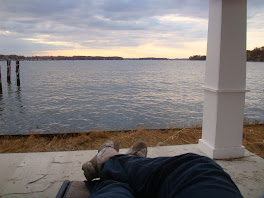
It's 9 November in Annapolis, Maryland, and warm enough to be sitting outside with my shoes off and a cashmere cape loose around my shoulders. But the important thing is where I'm sitting. We used to call it the "shelter by the water" and native Marylanders called it a crab shack, but now, with appropriate paperwork from Anne Arundel county and after spending a fairly large sum of money, it is an 8' x 11' gazebo on the South River (an arm of the Chesapeake Bay) supported by five white columns mounted on a clean, smooth concrete slab. Its ceiling is pegboard and its roof is a high grade medium gray metal, tilted at an angle that maximizes the waterview and minimizes the amount of time rain or snow will spend on it.
Its predecessor, which sat on metal poles in a rough cement slab had sheets of hard, semi-translucent plastic for a roof mounted in a wood frame. The cement and the poles remained in pretty good shape over the probably 20+ years of the old structure, but the winds that hit us from the west over the water during the winter took a toll on the roof, leaving chunks of plastic in our yard and gaping holes that undercut the shelter's utility in both sun and rain. It also had an impractically small homemade red brick charcoal grill built into it, which at some point we will replace with some snazzy propane-fueled thing. At one point the shelter also apparently had functioning electricity, and someday it will again.
That someday is much anticipated, not because of our desperate need to watch TV down by the water, but because the gazebo's electrification will mean that the renovation of our home will be complete. This will be the second renovation we have undertaken with our little water-front home. The first one turned an odd little termite-infested house owned by its 90-year old widowed builder who died in it (before having a chance to take his clothes out of the dryer) into a home for a mom, a dad, two kids and a dog.
The upcoming renovation has shifted from a two-phased effort to one big massive, expensive overhaul. Originally we expected first to expand the current one-story three-bedroom house to encompass the two porches that are largely unused and part of the current drive way, thereby expanding the kitchen, creating a foyer, expanding the family room, enhancing the closet and bathroom of the master bedroom, and adding a garage. The next phase would have been to put a second floor on to the house. Now we are trying for the whole thing at once, which will give us a huge five-bedroom house with outstanding waterfront views from expansive front and back decks, a sauna, and an elevator (for when my knees finally give out) that will take a year to build.
The fact that we have already spent a year or so in the design phase of the house is one of the many reasons that I'm so happy with the gazebo. It is the first step toward "Yes we can" in the process of completing the entire house project. Hear that, Anne Arundel County, which needs to grant us the permits to build (which shouldn't be a problem--it'll just cost us $$$$): YES WE CAN! Hear that, bank account? YES WE CAN!

Monday, September 22, 2008
Iraq and Mother Nature

After being in Iraq for over two months, I figured out that there are three colors native to at least this part of the country. Initially I thought there were four—the endless blue of the sky is perhaps the first thing you notice and are impressed with when you get here; but my observations suggest that over the long haul, the sky doesn't count because it is so much of a constant, and it is too bright to look at anyway. The sun is a rather weird object in Iraq during the spring, summer, and early fall. I can't say I ever saw it then, but believe me; I never had any doubt that it was around. I guess the bottom line is that you should not expect to see many multihued summer sunsets in Baghdad.
Anyway, I've already mentioned one of the three colors—that of the dust and most of Baghdad's buildings, including all of the palaces and villas I've seen, as well as the color of the trunks of the ubiquitous date palm trees (the Al-Rasheed Hotel's date bar at the 24-hour cafe has a sign on it saying that 480 types of dates are indigenous to Iraq). This color is khaki, not coincidentally the predominant shade of the US Army fatigues and the so-called "journalist vests" that all the tough civilian guys in Iraq wear to cover their 9mm pistols.
The second color is green--the shade of the former Republican Guard's wool uniforms. Even though grass grows around the Republican Palace and the hotel (thanks to constant watering) and a number of species of trees and plants in addition to the palms, the shade of green is pretty much the same everywhere, thanks to the taming process of the dust, which coats everything, including at times the sun and the sky.
It took me six weeks to detect the third color, but it became my favorite once my eyes had opened to it. It is a deep rich brown—has a lot of red in it. I think it was the squished dates on the ground at the hotel that first brought the shade to my attention, but then I realized that there's a type of rock here, I think of it as jasper, but I doubt if that's really it, that looks a lot like ripe dates (when they aren't squished). I collected particularly nice samples of these rocks, which are for the most part smooth and shiny, and carried them in my pocket and used them like large worry beads. But more than rocks and dates share this color—part of my education about this country has been to learn that shrapnel is this pretty shade, too. Or very close to it. I also started my own shrapnel collection because the destructive power of these chunks of metal that are all that's left of a multi-million dollar weapon fascinates me. They are like works of art in some twisted way, because they look sculpted. In any case, no one would mistake them for a product of Mother Nature.
So with respect to colors in Iraq, they all remind me of military stuff and war. They all make me think of sameness and regimentation and endurance over initiative. Maybe the north and the south of Iraq are different—I'd love to check that out—but in terms of the Sunni heartland, that's all there is and maybe in part that's why it is what it is . . . And unfortunately, in Iraq, a country with guns and explosives in plentiful supply and with a people who are trying to figure out what they want in life and whose loyalties are torn in any number of ways, reminders of war are a good thing because they keep you motivated and because if you forget at the wrong time, you just might get into trouble.
One last thing about the great Iraqi outdoors--be aware that from the moment you step off the plane there, you will be assigned a housefly. Sometimes I thought they were trained by Saddam's Iraqi Intelligence Service. I'm not sure if the same fly stays with you throughout your tour there, but I know that one is assigned to you each and every day, and he/she will get to know you as thoroughly as possible, including by sitting on your nose, walking on your glasses, caressing your cheek, and inspecting your mouth. I have thought, "Why can't humans appreciate this kind of attention?" but then I realized that the fact that I thought these thoughts suggests that Iraq really got to me in good ways and bad. And it will get to you, too.

Subscribe to:
Posts (Atom)


 Posts
Posts

